
Street = a paved public road that only appears in a city or town, not in rural areas.
Road = a route or way on land between two places that has been paved to allow travel by transport.
Avenue = a straight street (or road) with trees planted along both sides. Avenues are typically wider than streets, sometimes having more lanes and therefore more traffic.
An alley is a narrow passageway between or behind buildings. Often there is only enough space for a one vehicle in an alley or for none at all (just for pedestrians).
A boulevard is a wide tree-lined street, similar to an avenue though with a grass median strip (with trees and/or grass).
A highway is a major public road, usually connecting towns and cities.
A lane is a short narrow street usually without a sidewalk/footpath.
A path is not normally paved and is dedicated to pedestrians, not vehicles.
A pedestrian street is a street that has been closed to road vehicles. They are paved and you can only walk along them.
| rear-view mirror | is a mirror in a vehicle providing a view of the area behind it. She checked the rear-view mirror before changing lanes. |
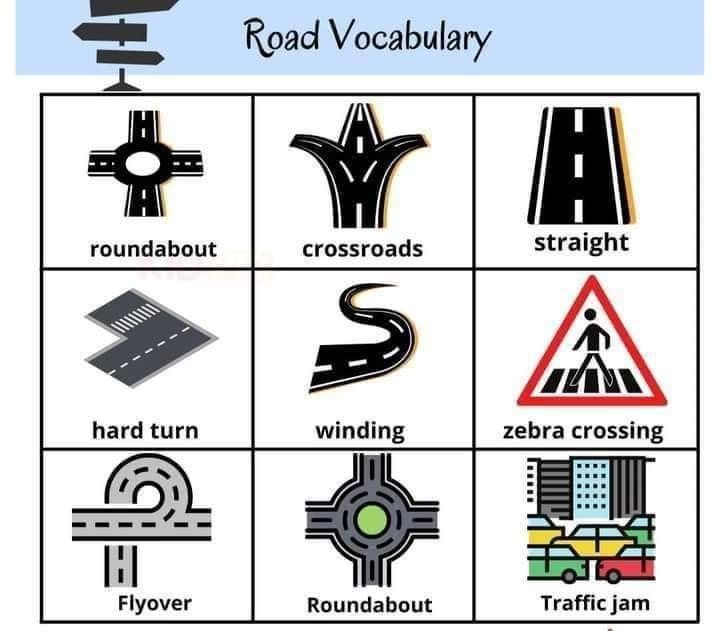
| roundabout | is a circular junction where drivers move around a central island. At the roundabout, he took the third exit. |
| pedestrian crossing (UK) crosswalk (US) | is a marked part of the road for pedestrians to cross. It is often also called zebra crossing. Cars stopped at the pedestrian crossing to let people walk across. |
| car crash road accident | is a collision involving one or more vehicles. There was a car crash on the highway this morning. |
| speed limit | is the maximum legal speed one can drive on a road. She was careful to follow the speed limit in the school zone. |
| speed bump | is a raised section of road designed to slow down traffic. Drivers have to slow down for the speed bumps near the school. |
| junction | is a point where two or more roads meet. There’s often heavy traffic at the junction during rush hour. |
| Rush hour | is a period of the day when traffic is at its heaviest, usually as people commute to and from work. Traffic during rush hour can be very slow. |
CAR


EXPRESSIONS
1 To turn on/start the car means to begin the operation of the vehicle.
- He started the car and began his morning commute.
2 To put on your seatbelt means to fasten the safety belt before driving.
- Before driving off, she put on her seatbelt.
3 To change gears means to shift the transmission to adjust the vehicle’s speed and power.
- He had to change gears as he drove up the steep hill.
4 To honk or honk the horn means to sound the horn of a vehicle.
- The driver honked at the pedestrians who were crossing slowly.
5 To brake means to slow down or stop the vehicle suddenly. If you slam on the brakes, it means that you are traveling fast and suddenly brake.
- She had to slam on the brakes when a dog ran into the road.
6 To put on/take off the emergency brake means to engage or disengage the brake that prevents the vehicle from moving when parked.
- After parking on the hill, he put on the emergency brake.
7 To stall means the engine stops running, often due to a mistake in gear changing.
- The car stalled when he forgot to press the clutch while stopping.
8 To signal right/left means to use the vehicle’s indicators to show an intention to turn or change lanes.
- She signaled left before making the turn.
9 If you have the right of way, you are legally allowed to go first before others in traffic.
- Pedestrians in the crosswalk have the right of way.
10 To give way (UK)/yield (US) means to allow others to go first, often at a junction or intersection.
- Drivers must yield to oncoming traffic.
11 To overtake means to pass another vehicle moving in the same direction.
- The truck was going slowly, so she decided to overtake it.
12 To speed means to drive faster than the legal limit.
- He was caught speeding on the highway and was fined.
13 To change lanes means to move from one lane to another.
- She checked her mirrors before she changed lanes.
14 To merge means to join another road, typically from a ramp or side road.
- He merged onto the freeway cautiously.
15 To be stuck in a traffic jam means to be caught in a line of slow-moving or stationary traffic.
- She was stuck in a traffic jam for an hour this morning.
16 To reverse means to drive the vehicle backward.
- He had to reverse the car out of the tight parking space.
17 To make a U-turn means to turn the vehicle around in a U-shaped course to go in the opposite direction.
- The road was blocked, so he had to make a U-turn.
18 To pull over means to steer the vehicle to the side of the road and bring it to a stop.
- The police officer signaled for her to pull over.
19 To get pulled over means to be stopped by the police while driving.
- He got pulled over for not using his turn signal.
20 To be fined/get a ticket means to receive a penalty, usually a monetary charge, for a driving infraction.
- She got a ticket for parking in a no-parking zone.